
Treatments
Mohs surgery
Mohs surgery is a gentle and highly precise operation for skin cancer. The cancer is removed layer by layer and examined under a microscope while you wait. This gives the highest cure rate, while we preserve as much healthy skin as possible.
Local anaesthetic
Performed under local anaesthetic only.
No hospital stay
You go home the same day.
A safe method
A safe method for removing skin cancer.
Cosmetic result
Gives a good cosmetic result.
About the method
What is Mohs surgery?
Mohs surgery is named after the American surgeon Frederic Mohs, who developed the method. It is used mainly for basal cell carcinoma and squamous cell carcinoma, the two most common forms of skin cancer.
In a standard operation, the cancer is removed with a fixed margin of healthy skin, and only part of the edges is examined. With Mohs surgery, we examine the entire edge and base of the removed tissue under a microscope. This lets us see whether any cancer remains at the edges, and remove more tissue precisely where it does.
The method is particularly suitable for skin cancer that grows aggressively or has a high risk of coming back, and for the face, where it is important to preserve as much healthy skin as possible. Mohs surgery is the gold standard in the USA, Australia, the UK and many other European countries.
Skin Cancer Clinic is the only private clinic in Denmark that treats skin cancer with Mohs surgery.
- 40%
- up to 40% less tissue is removed compared with standard surgical excision.
- 97.9%
- cure rate for basal cell carcinoma that has not been treated before.
- 94.8%
- cure rate for basal cell carcinoma that has been treated before.
Figures from a Swedish study. See the study on PubMed
Step by step
How a Mohs operation works
-
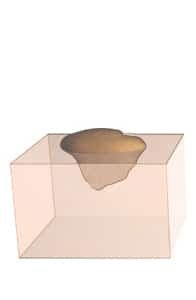
Step 1
Anaesthetic and marking
The doctor examines and marks the visible part of the cancer. The area is numbed, so you are awake but feel no pain.
-
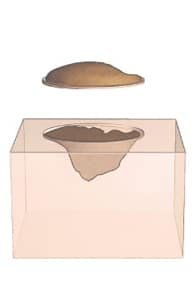
Step 2
The first layer is removed
The visible cancer is removed together with a thin layer of tissue. The wound is covered with a dressing, and you wait while the tissue is examined.
-
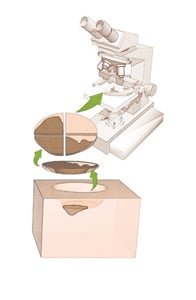
Step 3
Examination under a microscope
The tissue is divided into smaller pieces, colour-marked and drawn onto a map. The doctor examines the entire edge and base under a microscope.
-
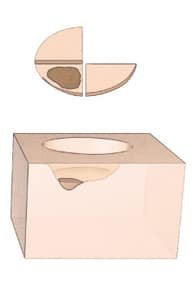
Step 4
Remaining cancer is located precisely
If any cancer cells remain, the map shows exactly where. The healthy skin around them is left in place.
-
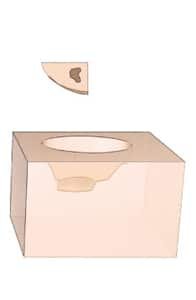
Step 5
A new layer, only there
A new thin layer is removed exactly where cancer remained, and it is examined in the same way. This is repeated until there are no more cancer cells.
When all edges are clear of cancer, the wound is closed. This is usually done with stitches, and sometimes with a small skin flap or a skin graft. The doctor will go through the options with you.
Questions and answers
Good to know before your operation
Who can be treated with Mohs surgery?
Mohs surgery is used mainly for basal cell carcinoma and squamous cell carcinoma when the cancer is on the face or somewhere else where it is important to spare healthy skin. It is also suitable when the cancer has unclear borders, or when it has come back after previous treatment. At the consultation, the doctor assesses whether Mohs surgery is the right treatment for you.
Does it hurt?
You are given a local anaesthetic, so you only feel the prick of the needle. If more layers are needed, we numb the area again. After the operation, the area may be sore for a few days. Ordinary painkillers are usually enough.
How long does it take?
The first part of the operation usually takes 20 minutes, and it takes around 30 minutes to examine the removed tissue under the microscope. Typically, tissue needs to be removed and examined in 1–3 rounds, but this varies from patient to patient. An operation, including time in the waiting room, will therefore normally take about 3–4 hours on a single day.
Will I need to stay in hospital?
No. The operation is performed under local anaesthetic only, and you go home the same day.
How do I prepare?
Eat breakfast as normal and take your usual medication. Tell us in advance if you take blood-thinning medication, but never stop taking it without talking to a doctor.
How is the wound closed?
Most often the wound is stitched together. For larger wounds, we may move a small skin flap from the neighbouring area or use a skin graft. Small wounds can also be left to heal on their own.
What happens after the operation?
When the operation is over, you wait 15–20 minutes before going home, so we can see that you are feeling well and not bleeding. The wound is given a bandage, which stays on until the stitches are removed. After 5–7 days you come back for a check-up and to have the stitches removed. We arrange that appointment with you on the day of the operation.
Will I get a scar?
All operations leave a scar. Because Mohs surgery removes only the tissue that is necessary, the wound is kept as small as possible. This gives the best conditions for a good result, and the scar usually fades over the first few months.
Do I need a referral?
No. You can book a consultation directly. If you have already had a tissue sample taken, please bring the result with you.
Private clinic
Appointments straight away
As a private clinic, we can offer short waiting times and a fast diagnosis – no referral needed. You can usually get an appointment straight away, so your concerns can be resolved quickly.
Book an appointment